
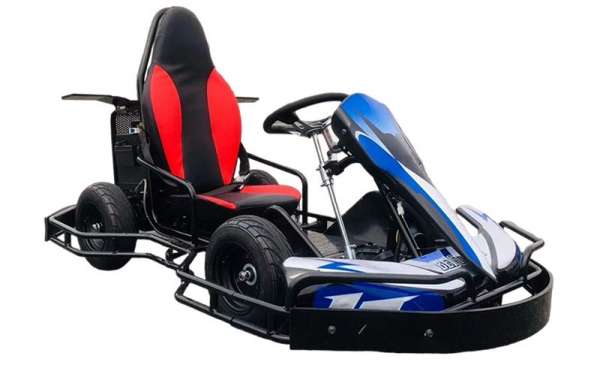
The design philosophy behind vehicles for off-road karting centers on durability, traction, and driver safety in unpredictable environments. Every major component is reinforced compared to its asphalt counterpart. The chassis is constructed from heavy-gauge steel tubing, forming a rigid yet flexible frame that can withstand torsional stress from uneven ground. A key feature is the integrated roll cage, which protects the driver if the vehicle tips over, a realistic possibility in off-road karting. The suspension system is the heart of the vehicle's performance. Independent or solid axle setups with adjustable coil-over shock absorbers allow the kart to articulate over bumps and holes, keeping all wheels on the ground to maximize drive and steering control. Ground clearance is also increased to prevent the vehicle's underside from scraping on rocks or ruts.
The drivetrain and tires are specifically adapted for off-road karting conditions. Engines are typically air-cooled, four-stroke units between 200cc and 400cc, chosen for their reliable low-end and mid-range torque rather than pure top speed. This torque is essential for accelerating out of corners on low-grip surfaces and climbing steep inclines. Power is transmitted through a torque converter or a centrifugal clutch connected to a live rear axle, providing seamless power delivery without the need for manual gear shifting. The tires are perhaps the most visual indicator of an off-road karting machine. They are large-diameter, wide balloons with aggressive, self-cleaning tread blocks. These tires flex to conform to the terrain, providing a larger contact patch, and the deep tread evacuates mud to find harder ground beneath. For very muddy conditions, specialized tires with even more pronounced lugs are used.
The terrain itself defines the challenge of off-road karting. A typical course might include a mix of hard-packed dirt, loose gravel, muddy sections, and sand traps. Each surface demands a different approach. Drivers must constantly adjust their technique; for instance, carrying more speed through a hard-packed berm but slowing and using momentum to skim across a deep sand section. Man-made obstacles like tabletop jumps, whoops, and banked corners add to the technical demands. Navigating a jump safely in off-road karting requires precise throttle control on the approach to ensure a level take-off and a smooth landing. Weather dramatically alters track conditions, making each session unique. Rain can turn a dusty track into a slippery mud bath, fundamentally changing grip levels and racing lines. This ever-changing environment is a core attraction of off-road karting, as it tests a driver's adaptability and machine setup continually, ensuring no two laps are ever exactly the same.