
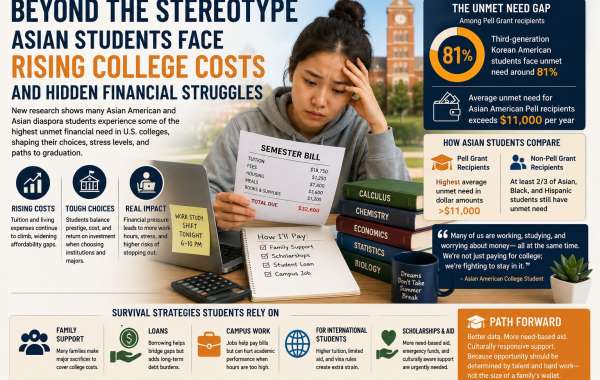
The conversation around college affordability often focuses on average tuition prices and student loan balances. Yet for many Asian American and Asian diaspora students, the financial challenge runs much deeper. Rising tuition is only part of the story. A growing body of research shows that large gaps between college costs and available aid—known as unmet financial need—are shaping everything from college choice to career plans.
Recent findings reveal that some Asian-origin student groups experience unmet need rates above 80 percent. These numbers challenge long-standing assumptions that Asian students generally come from financially secure backgrounds. Instead, the data point to a more complicated reality where many students and families are quietly struggling to make higher education affordable.
The Affordability Gap Is Larger Than Many Realize
The biggest issue facing many students is not simply tuition. Housing, food, transportation, and campus fees continue to increase alongside tuition costs. Even after grants and expected family contributions are calculated, many students still face significant funding shortfalls.
Research highlighted in the report shows that Asian American Pell Grant recipients face some of the highest average unmet financial need levels among all student groups, often exceeding $11,000 annually. That means students must find alternative ways to cover thousands of dollars each year simply to stay enrolled.
Imagine building a bridge where every section is funded except the final span. No matter how much work has already been completed, the project cannot reach the other side until that gap is closed. College financing works much the same way. A relatively small funding shortfall can determine whether a student graduates or leaves school early.
Financial Pressure Is Changing Academic Decisions
Money is increasingly influencing what students study.
Many Asian students feel pressure to choose majors with clear earning potential. Engineering, computer science, healthcare, and business programs often appear safer because they promise stronger salaries after graduation. As tuition rises, students frequently view degree selection through the lens of return on investment rather than personal interest.
The report notes that some students switch away from humanities or arts programs after calculating future debt burdens. Others pursue double majors or additional certifications to improve job prospects, even when doing so extends their time in college and increases costs.
This trend reflects a broader shift in higher education. Students are treating academic decisions more like financial investments, weighing future income against current borrowing needs.
For students looking for academic support while balancing coursework and financial pressures, resources such as Expertsmind.com's online subject expert network can help provide tutoring and assignment guidance without adding the scheduling challenges that often come with traditional in-person support.
Family Support Remains a Major Financial Lifeline
Family contributions continue to play a central role in financing education for many Asian students. Cultural expectations around education often encourage parents and extended family members to make significant sacrifices to support college attendance.
Families may draw from savings, postpone retirement plans, take on additional work, or borrow through parent loan programs. While these efforts can help students complete their degrees, they often transfer financial stress from one generation to another.
Students whose families cannot provide substantial assistance frequently rely on a combination of scholarships, student loans, and part-time employment. The challenge is that scholarship opportunities are highly competitive, and loans can create long-term financial obligations that follow graduates for years after leaving college.
The result is a funding strategy that often resembles a patchwork solution rather than a stable financial plan.
Working More Hours Comes With Hidden Costs
Many students respond to affordability challenges by increasing their work hours. Campus jobs, off-campus employment, freelance work, and gig economy opportunities have become common tools for filling financial gaps.
While employment can provide necessary income, it also creates trade-offs. Research consistently links excessive work hours during college with lower academic performance, increased stress, and higher dropout risk. The report highlights that Asian students often carry additional family responsibilities, including helping with family businesses, translating documents, or caring for relatives. These obligations add to their overall workload even when they are not formally employed.
When academic responsibilities, employment, and family duties collide, students may reduce course loads or delay graduation. What begins as a strategy to save money can ultimately increase total educational costs by extending the time required to earn a degree.
Why the “Model Minority” Narrative Misses the Real Problem
One reason these financial struggles remain overlooked is the persistence of the model minority stereotype. Aggregate statistics often portray Asian students as uniformly successful, masking significant differences between ethnic subgroups and generations.
The report emphasizes that disaggregated data tell a very different story. Some Asian communities experience poverty rates, unmet need levels, and educational barriers that are hidden when all Asian students are grouped together. As a result, institutions and policymakers may underestimate the level of support certain students require.
This creates what researchers describe as invisible need. Students appear to be succeeding on the surface while managing debt, long work hours, and financial anxiety behind the scenes.
Recognizing these differences is essential. Effective financial aid policies depend on accurate data, and accurate data require a more detailed understanding of the diverse experiences within Asian American and diaspora communities.
The evidence is clear: rising tuition is not affecting all students equally. For many Asian students, the challenge is not simply paying for college. It is managing a complex web of financial obligations, family expectations, academic demands, and future career concerns. Addressing these pressures will require more targeted aid, better data collection, and a willingness to move beyond stereotypes. Until then, thousands of students will continue relying on survival strategies that help them stay enrolled today but may create financial consequences that last long after graduation.