
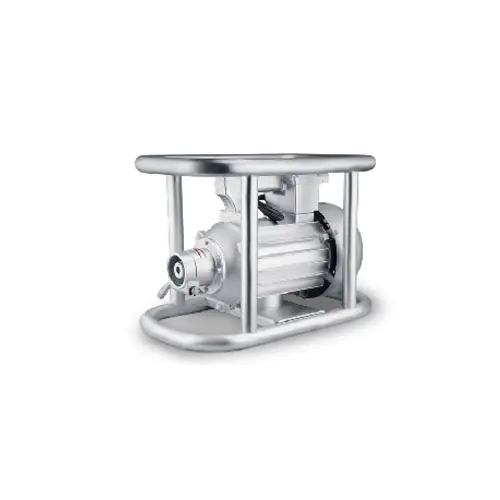
A Concrete Batching Plant Vibrator Motor is primarily used to support material movement rather than simply produce as much vibration as possible. When aggregate forms a bridge inside a hopper, vibration can help loosen the material and encourage it toward the outlet. However, excessive vibration may create unwanted movement around weighing equipment, so the required centrifugal force needs to correspond with the hopper structure and the material being handled. This makes application conditions more useful than a single output figure when selecting a motor.
Motor speed and pole configuration are also closely related to vibration behavior. Industrial vibration motors are commonly available in configurations such as 2-pole, 4-pole, 6-pole, and 8-pole designs. Higher-frequency vibration can suit certain smaller or lighter applications, while slower vibration with greater amplitude may be more appropriate for heavier bins or materials that compact more easily. The choice depends on the mass, flow characteristics, and geometry of the equipment rather than simply selecting the motor with the highest rated power.
The operating environment presents another consideration. Concrete batching plants generate considerable amounts of dust, and vibration equipment may also experience frequent starting and stopping during production cycles. Motor housings, terminal boxes, cable entries, and sealing arrangements therefore need to be suitable for the surrounding conditions. Bearings are another important component because vibration motors experience continuous mechanical forces that differ from those encountered by ordinary rotating motors. These construction details can influence service performance when the equipment operates repeatedly in a demanding environment.
Installation position also affects the selection. Aggregate hoppers may require vibration to prevent coarse materials from bridging during discharge, while cement or fly-ash storage equipment can need vibration to help loosen compacted powders. Smaller vibration units may also be installed around chutes or other material-transfer points. The mounting surface, available space, bin dimensions, and direction of the applied force all need to be considered before determining the appropriate motor configuration.
For equipment distributors and batching plant integrators, several specifications can be compared during sourcing. Voltage and frequency need to match the local electrical system, while mounting dimensions should correspond with the existing hopper or silo structure. Centrifugal force, pole configuration, protection level, and available mounting arrangements can also affect compatibility. When a plant contains several types of vibrating equipment, using compatible motor configurations may simplify maintenance and spare-parts planning.
A Concrete Batching Plant Vibrator Motor is therefore best considered as part of the complete material-flow system. Hopper dimensions, material properties, mounting location, vibration frequency, electrical requirements, and environmental conditions all influence the final specification. Treating these factors together can help ensure that vibration supports consistent discharge without introducing unnecessary movement elsewhere in the batching process.