
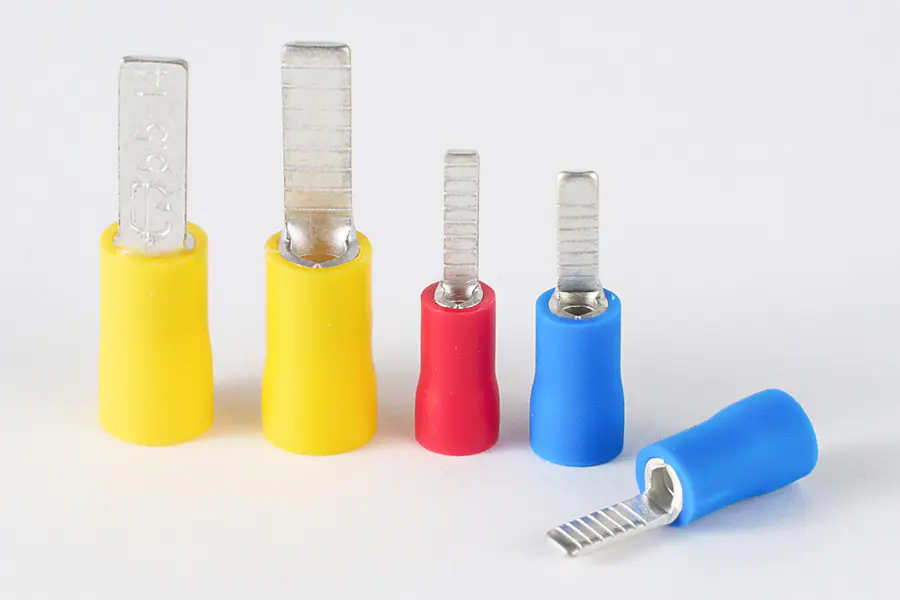
The current-carrying capacity of a terminal begins with its physical dimensions. In Blade Terminals Connectors, the width and cross-sectional area of the conductive blade influence resistance and heat generation. Common blade sizes such as 0.110, 0.187, and 0.250 inches are designed for different connection requirements. A wider blade generally provides a larger conductive path and more contact area with the mating receptacle. However, blade size alone cannot determine the actual current capacity after installation.
The connection between the terminal and wire is equally important. A properly sized terminal can develop excessive resistance if the crimp is loose, poorly positioned, or made with an unsuitable crimping method. The same issue can occur at the mating interface if the blade does not sit correctly inside the female receptacle. Increased resistance at either point produces localized heat, which can affect long-term electrical performance. For production applications, checking crimp height, pull force, or electrical resistance can provide more useful information than visual inspection alone.
Ambient temperature also changes the conditions under which a terminal operates. A connection inside a temperature-controlled electrical enclosure has more opportunity to dissipate heat than one installed near an engine, heating element, or other high-temperature component. When the surrounding temperature rises, the available thermal margin becomes smaller. For Blade Terminals Connectors used near their rated current, temperature conditions therefore need to be considered together with the nominal electrical rating.
Wire selection provides another important part of the connection. Insulated blade terminals commonly use color coding to indicate compatible wire gauges, such as red, blue, or yellow insulation for different wire-size ranges. This coding primarily helps installers match the terminal to the conductor rather than directly indicating current capacity. An incorrect wire-terminal combination can result in an unreliable crimp and increased electrical resistance.
Material and surface treatment can also influence performance over time. Copper provides good electrical conductivity, while tin or nickel plating can help protect the contact surface against oxidation and environmental exposure. In humid, corrosive, or contaminated environments, maintaining a clean mating surface becomes particularly important because surface degradation can increase contact resistance.
For this reason, evaluating Blade Terminals Connectors requires looking at the complete connection rather than one specification in isolation. Blade dimensions, wire gauge, crimp quality, mating force, ambient temperature, material, and plating all contribute to how the terminal performs under its actual operating conditions.