A building can be physically complete while its information is still unfinished. For a facility manager, that gap can become a daily operational problem: equipment locations are unclear, drawings no longer match field conditions, renovation records are scattered, and maintenance teams spend time verifying information that should already be available.
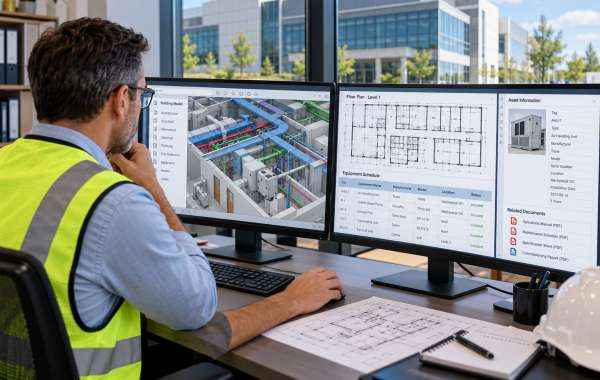
Digital as-built documentation addresses this problem by turning construction changes and verified field conditions into a usable record of the facility. The documentation may include updated drawings, models, equipment information, schedules, specifications, and other data needed after handover. For teams responsible for maintaining or modifying a facility, accurate CAD documentation is therefore more than a record of what was built—it is an operational reference. For example, 3D CAD Drafting Services can be relevant when a project requires accurate digital representation of existing or completed conditions.
As-built documentation is not simply a set of “final drawings”
One common misconception is that an as-built package is just a marked-up construction drawing converted into a PDF. In practice, useful handover information can be much broader.
The National Institute of Building Sciences describes COBie as a standardized way to organize information used to manage and maintain facility assets. Its scope can combine space, product, and equipment schedules with as-built, operations and maintenance, and commissioning information captured during construction. National Institute of Building Sciences
That distinction matters because facility managers do not operate buildings by looking only at floor plans. They need to answer questions such as:
- Where is a particular piece of equipment installed?
- Which room or system does it serve?
- What model or type of equipment is it?
- What documentation belongs to it?
- Has the installed condition changed from the design?
- Which components will be affected by a proposed renovation?
- Where are critical valves, panels, access points, or service areas located?
A drawing may answer one of these questions while an asset database, BIM model, equipment schedule, or linked document answers another. The objective is to make the information consistent and usable rather than simply accumulating files.
The real value appears when someone needs to change the building
The usefulness of an as-built record often becomes obvious during a renovation, repair, inspection, or space reconfiguration.
Consider a hypothetical office building in which a mechanical room has been modified several times. The original drawings show one arrangement, a later PDF shows another, and a contractor's redlines document some—but not all—of the changes. A facility manager planning a new installation now has to determine which information reflects reality.
A properly maintained digital record can reduce that uncertainty.
For example, a coordinated record might include:
Information | Why it matters to facilities |
Updated floor plans | Locating spaces, walls, equipment, and access areas |
Equipment schedules | Identifying assets and their associated information |
Reflected ceiling plans | Understanding services and ceiling-mounted components |
MEP documentation | Supporting maintenance and renovation planning |
3D/BIM model | Providing spatial and relational information |
Asset data | Connecting equipment to maintenance requirements |
Revision history | Showing what changed and when |
Linked O&M documents | Giving technicians access to relevant manuals and records |
NIST's facilities handover guidance similarly emphasizes the exchange of facilities information from project inception through operations, maintenance, and eventual disposal. NIST
The important point is that digital as-built documentation should be designed around future decisions, not merely around the closing requirements of a construction contract.
What should facility managers expect in a digital handover?
There is no single package that fits every building. The appropriate deliverables depend on the facility, contractual requirements, asset-management system, and intended uses.
Still, several categories deserve particular attention.
1. Spatial information
Floor plans, room information, levels, zones, and coordinates establish the spatial framework of the facility. This information becomes particularly important when assets need to be located quickly or when a renovation affects multiple rooms or building systems.
2. Maintainable asset information
Facility managers need more than the name of an equipment category. Depending on the project, useful asset data may include manufacturer, model, serial number, installation location, system association, warranty information, and maintenance-related documentation.
COBie is specifically intended to support digital delivery of information about maintainable assets, including mechanical and electrical equipment and other items that owners manage through operations and maintenance systems. National Institute of Building Sciences
3. Updated drawings and models
The digital record should distinguish between design intent and verified installed conditions. Where a BIM model is part of the project deliverable, its usefulness depends on whether the information inside it corresponds to the owner's requirements.
COBie itself is not a replacement for every graphical model or drawing. NIBS describes it as a subset of BIM content focused on structured, non-graphic information and notes that it can also be represented in spreadsheet form. National Institute of Building Sciences
That means a strong handover may involve both graphical documentation and structured asset information.
4. Documents associated with assets
A useful digital handover can connect equipment records to manuals, commissioning information, warranties, inspection records, or other relevant documents. The goal is to reduce the need to search through disconnected folders whenever an asset requires attention.
Why revision control matters after handover
An accurate as-built model or drawing can quickly become inaccurate if subsequent modifications are not recorded.
This creates a deceptively difficult problem. A facility can have excellent documentation at handover and still develop poor documentation within a few years if renovations, equipment replacements, tenant improvements, and system changes are recorded inconsistently.
A practical revision process should answer four questions:
- What changed?
- Where did it change?
- When was it changed?
- Which document or model represents the current condition?
Revision identifiers, dates, change descriptions, and controlled file locations help establish that chain of information.
This is especially important when several disciplines are involved. An architectural modification can affect mechanical services; a new electrical installation can affect architectural layouts; and equipment replacement can alter both spatial coordination and maintenance information.
Interoperability is part of the handover decision
A facility manager should not evaluate digital documentation solely by asking whether a file opens today. The more important question is whether the information can remain useful within the organization's future software environment.
Common formats serve different purposes. DWG and DXF are widely associated with CAD workflows, while STEP and IGES are used for exchanging 3D product and engineering geometry. PDF remains useful for fixed-format viewing and archival documentation. BIM workflows may also involve IFC, an open standard used for exchanging building information.
The appropriate format depends on the downstream application. A facility owner should therefore define required formats before handover rather than accepting whatever format happens to be produced at the end of the project.
COBie illustrates this broader principle: its information can be associated with BIM/IFC workflows while also being represented in spreadsheet form, providing a structured way to exchange asset information. buildingSMART International
The handover process should begin before construction finishes
Waiting until the last week of a project to assemble as-built information creates avoidable problems.
Information is generated throughout design and construction. Equipment is selected, installed, tested, relocated, replaced, and commissioned at different stages. If those changes are captured only at the end, reconstructing the complete record can become difficult.
NIBS describes COBie as a process in which project stakeholders contribute information at specified milestones, culminating in a fuller delivery at project handover. Stakeholders can include architects, engineers, contractors, suppliers, trades, commissioning agents, and the facility owner. NBIMS
This suggests a better approach: define the information requirement early and update it progressively.
For facility managers, that also means participating in the definition of deliverables. The question should not simply be “What drawings will the contractor provide?” It should be “What information will the operations team need to maintain this facility?”
A practical checklist for reviewing as-built documentation
Before accepting a digital handover, facility teams can review the package against questions like these:
Accuracy
- Do drawings reflect verified installed conditions?
- Are major equipment locations correct?
- Are significant field changes incorporated?
Completeness
- Are relevant architectural, structural, mechanical, electrical, and plumbing records included?
- Are maintainable assets identified?
- Are supporting manuals and commissioning records available where required?
Consistency
- Do drawings, models, schedules, and asset records agree?
- Are equipment identifiers consistent across documents?
Usability
- Can staff locate files without specialized knowledge?
- Are file names and folder structures logical?
- Can the information be imported into the intended facilities-management system?
Interoperability
- Are required native and exchange formats included?
- Can future teams access the information without depending on one proprietary workflow?
Change management
- Is there a clear revision history?
- Is the current record distinguishable from superseded information?
These checks can expose problems that a simple “all files received” review would miss.
The best as-built record is designed for the next person
Digital as-built documentation has a longer useful life when it is treated as operational information rather than project paperwork.
That means thinking beyond the construction team's immediate needs. A technician may need to find a valve. A maintenance planner may need equipment attributes. A project manager may need to understand existing conditions before approving a renovation. A future designer may need reliable geometry. An owner may need structured asset data for a facilities-management platform.
The common requirement is trust: people need confidence that the digital record represents the facility they are actually responsible for.
COBie was developed around precisely this handover challenge. Its stated purpose is to help project teams capture and deliver facility asset information digitally so owners can use that information in operations and maintenance systems without an unnecessary gap after handover. National Institute of Building Sciences
For that reason, the strongest digital as-built strategy is not simply “produce more drawings.” It is to establish a controlled, coordinated information record that connects geometry, assets, documents, and revisions to the way the facility will actually be operated.
Sources
- National Institute of Building Sciences, COBie V3 Standard — overview, purpose, process, and structure. National Institute of Building Sciences
- NIST, Capital Facilities Information Handover Guide (NISTIR 7259) — guidance on facilities information exchange through operations and maintenance. NIST
- buildingSMART COBie, COBie Standard and History — development and application of digital handover information. cobiecert.buildingsmart.org