
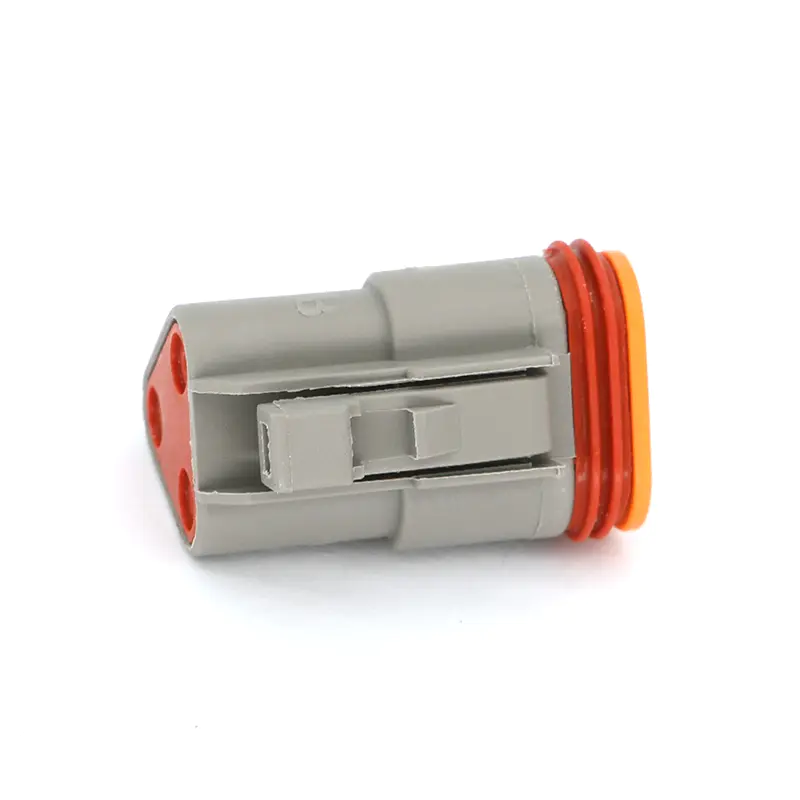
In an automotive wiring harness, connector selection involves more than counting contact positions. A 3-Way Plug Assembly provides three contact positions within a single housing, but its suitability depends on the electrical circuit, wire specifications, mating interface, and installation environment. Checking these details early can reduce mismatches during harness assembly and installation.
The mating connector is an important starting point. A three-position plug must fit its corresponding receptacle, including the housing geometry, contact arrangement, and locking interface. Overall dimensions also affect installation. When connectors are placed near brackets, enclosures, or other wire branches, designers need to allow enough space for mating, disconnection, and wire routing. Reviewing both halves of the connection gives a more complete picture than specifying the plug alone.
Electrical specifications require the same attention. Contact current rating, voltage rating, and supported wire gauge should match the intended circuit and selected terminals. A connector with three positions is not necessarily suitable for every three-wire application. The conductor, terminal, and crimp termination must also be compatible with the selected housing and assembly process.
Environmental requirements can further narrow the available options. Automotive connectors may be exposed to vibration, temperature changes, moisture, dust, or cleaning processes, depending on where they are installed. Housing material, locking structure, operating temperature range, and ingress protection ratings should therefore be reviewed against the actual application. Protection ratings for a connector product should not automatically be treated as proof that the entire assembled harness has equivalent protection.
Crimp quality is another consideration for harness production. The terminal and wire must be matched to the appropriate crimp specifications and tooling. An unsuitable combination can affect electrical contact and mechanical retention, even when the housing fits correctly. Clear assembly instructions and appropriate inspection procedures help maintain consistency between production batches.
For distributors and harness manufacturers, accurate product identification also matters. Records should distinguish mating configuration, contact count, pitch, dimensions, mounting style, wire range, electrical ratings, and model number. These details make it easier to compare alternatives, manage replacement parts, and communicate requirements between engineering, purchasing, and production teams.
A 3-Way Plug Assembly should ultimately be evaluated as part of the complete wiring connection rather than as an isolated three-position component. Matching its mechanical, electrical, and environmental specifications to the application helps ensure that the selected connector is appropriate for the intended harness layout.